Sommario
The sacred statue of Lama Gangchen Rinpoche: devotion and support for our practice
A mandala of energy radiating from Albagnano in the ten directions: this is the spiritual and material legacy left to us by Lama Gangchen Rinpoche.
He transmitted to us the precious NgalSo practices such as NgalSo Tantric Self-Healing and Making Peace with the Environment. He believed in creating a sacred space where anyone seeking inner peace would be welcomed. That is why today we have the Temple — a jewel of modern architecture inspired by tradition — and the stupa, which houses his sacred body and helps us keep alive our devotion to the guru. Above all, he believed in us and in our ability to keep his lineage alive.
His images — whether photographs or paintings — accompany us everywhere and remind us of the most precious gifts we received from him. For those who knew him in person — or even shared the most important part of their lives with him — and for those who knew him only through meditation: we all have at least one sacred image bearing the face or figure of Lama Gangchen Rinpoche.
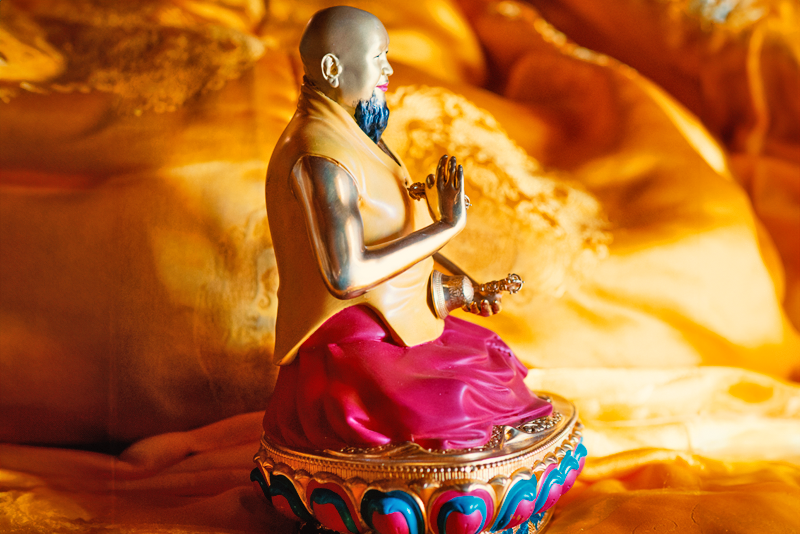
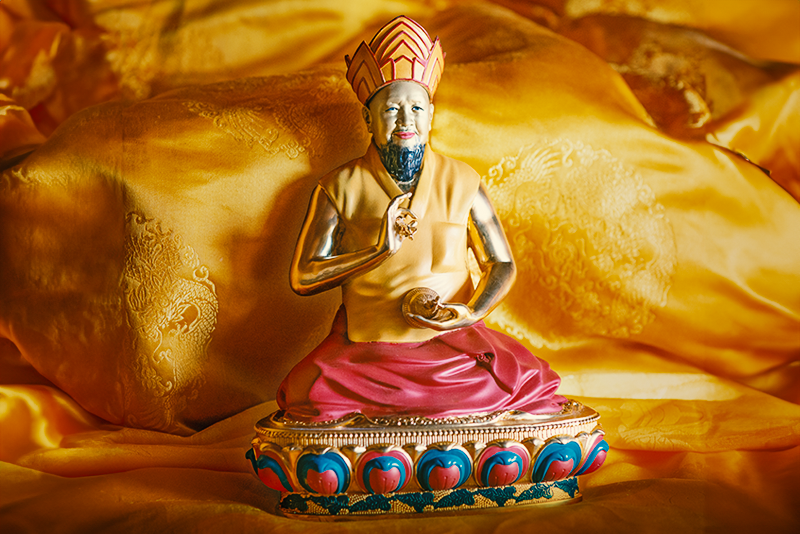
We now have a very special opportunity: to have a three-dimensional representation of his body, a bronze statue enriched with sacred mantras and objects that belonged to Lama Gangchen in the gompas of Albagnano and Milan, as well as in all NgalSo centres worldwide. Through the Rabne ceremony, these representations of our guru’s body will be inextricably linked to his mind, continuing to sustain our devotion and spiritual practice.
It was not an easy task to create a figure that resembled the Lama Gangchen we knew: above all, it was not easy to capture his facial expression. After several attempts, a good likeness was achieved.
The order for the statues will be placed at the end of August, and they will arrive in late November. They will then be filled and blessed. The large statues will be placed in the meditation halls in Albagnano and Milan, while the remaining statues will be prepared for the other centres. Donors who contributed the suggested amount or more will have the opportunity to receive a complimentary statue. Whatever support you choose to offer — whether small or large — it will be a tangible sign of your participation in realising this wish of our masters.
A special thanks to Tiziana Ciasullo, attendant to Lama Gangchen Rinpoche since 1991, for guiding the creation of the statue step-by-step under the supervision of Lama Michel Rinpoche.
If you are reading this news, you are part of this story. Your curiosity, your friendship, and your support help keep this place alive.
There is no moment more emotional or moving than the anniversary of Lama Gangchen Rinpoche’s birth. Alongside the anniversary of his passing into parinirvana, these days of celebrating our gratitude towards Lama Gangchen and his extraordinary life are moments of great significance for us all.
Joy and sadness are both present during these days: joy for what we have received from him – and joy at his reincarnation – and, at the same time, sadness at the sense of loss that many still feel and express today, six years after his death. With offerings of water, incense, and flowers at the stupa, as well as celebrations in the gompa and many special events, numerous people visited the Centre and participated in the scheduled programme with great enthusiasm.
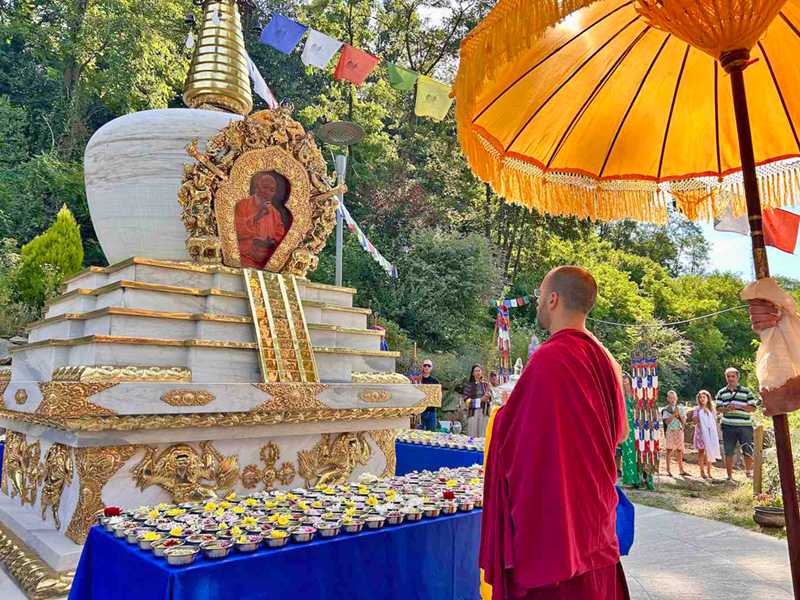
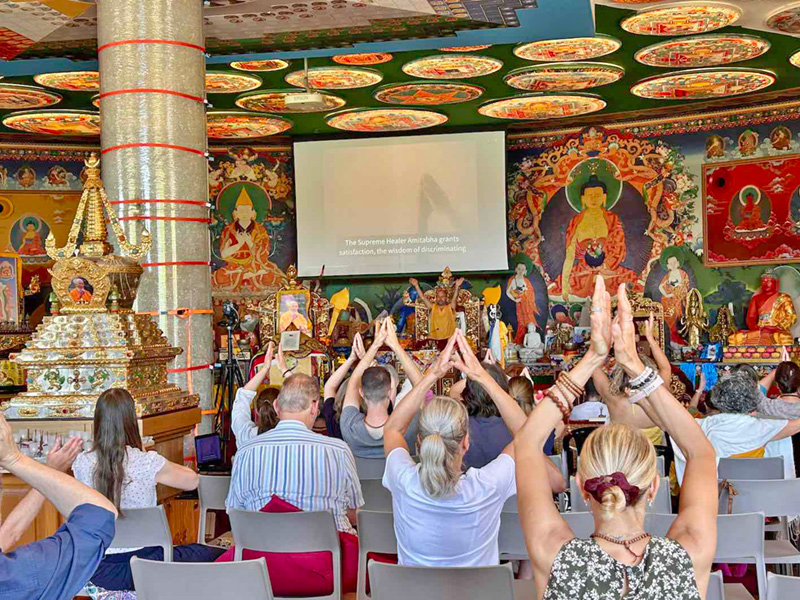
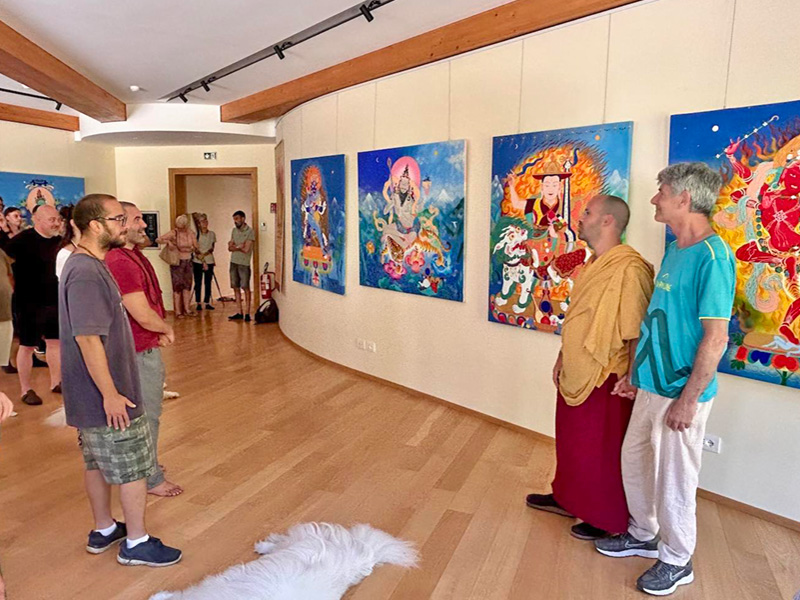
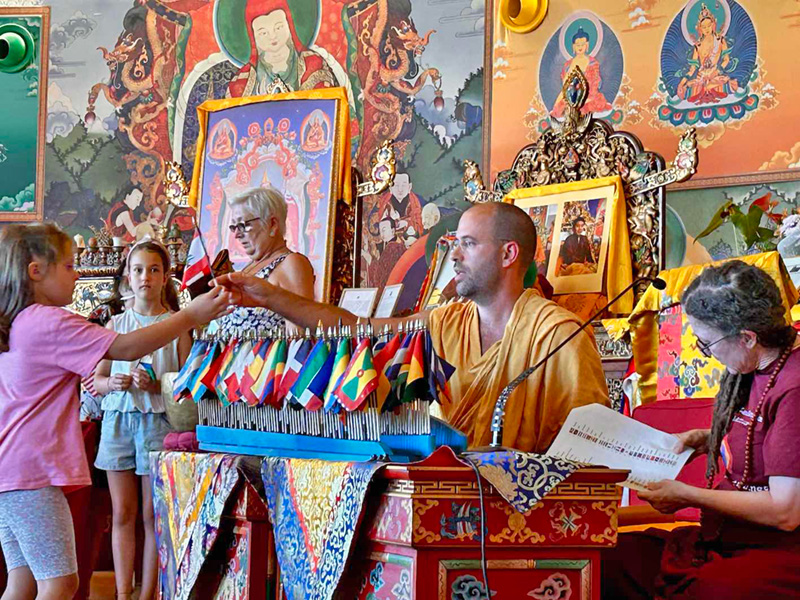
A series of events took place from July 4 to 7, including a worldwide NgalSo Tantric Self-Healing practice, the unveiling of the new support for the “Peace Bell,” an exhibition of sacred art by Leonardo “Duccio” Ceglie, a collective reading of the “Fortunate Eon Sutra,” and screenings of videos featuring special moments and interviews with Lama Gangchen. Other highlights included a dramatic reading of the children’s story “The Rainbow Master,” the presentation of “Wishfulfilling Jewels,” the Peace Flag ceremony, and a grand finale featuring a procession with Rinpoche’s relics. The programme was further enriched on the evening of July 7 by a concert from Maria Mazzotta, who moved the audience with her passionate rendition of the om mani peme hum mantra.
During this busy programme, a special moment was set aside for the preview screening of an interview with Trijang Choktrul Rinpoche. In his lengthy talk, translated by Lama Michel Rinpoche, who was with him at his home in Vermont, he explained the profound significance of a tulku’s reincarnation and shared personal experiences and heartfelt sentiments regarding Lama Gangchen.
Trijang Rinpoche — who on several occasions, with great emotion, expressed his affection for Lama Gangchen — said at one point: “When I saw Francesco Naropa, Lama Gangchen’s reincarnation, I felt a mixture of joy and sadness: the joy of finding my friend again, and the sadness of no longer having him close to me.”
The legacy of Lama Gangchen Rinpoche is immense: a precious treasure available to anyone seeking inner peace. This is the reason for Albagnano’s existence and the reason for the many resources prepared and maintained by dedicated practitioners: the YouTube channels, the podcasts, the sadhanas and books, the gardens, and the buildings along with the entire hospitality sector that manages welcoming visitors to the Centre and Temple, as well as their maintenance.
Kadrin Drenso is not merely an annual celebration it is also all of this: offering the ideal conditions for cultivating inner peace.
Ideas for cherishing memories
Did you know Lama Gangchen? What is the fondest memory you hold in your heart? If you didn’t know him personally, what touched your heart in the stories you’ve heard, the videos you’ve watched, and the practices he shared with us?
Glossary: Who is a tulku? In the Tibetan language, it means “emanation body” and refers to a spiritual master or Bodhisattva who has control over his/her own rebirths and continues to reincarnate in order to help beings.
If you are reading this news, you are part of this story. Your curiosity, your friendship, and your support help keep this place alive.
We all want to heal our physical and mental ailments, however minor or serious they may be. You’ve probably experienced a headache or a stomach ache at some point. Perhaps you have also recently started practicing mindful breathing and meditation, following the guidance of a teacher. Maybe something is gradually changing, and you have realised just how inseparably linked the mind and body are, and how much one influences the other: the body affecting the mind, and the mind affecting the body.
Dharma medicine is not a substitute for medical treatment or therapy – nor for other very useful ancient techniques – but it has the power to transform our subtle energy and to spread its vibrations throughout our entire being, even to our relationships and the environment in which we live. Every full moon, the Medicine Buddha puja is celebrated at the Albagnano Temple, with the very aim of supporting this inner healing process.
If you enter the Temple and have the text then it is not difficult to follow the recitation.
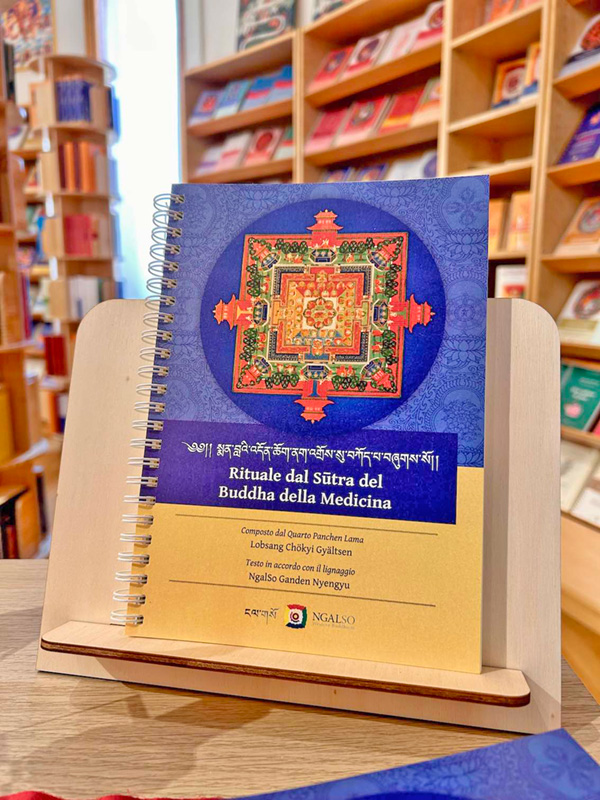
For this reason, over the past couple of years, we have begun creating a special edition of all the sadhanas we use regularly in the gompa. The first one — produced thanks to everyone’s generous participation — was the Guru Puja. The next will be the Medicine Buddha.
The colour of the cover will obviously be blue, as blue is the colour of the Buddha associated with inner healing. We invite you to join us via live stream or in person at the Temple during the next full moon to experience the benefits of this sadhana together. You will also find the new sadhana in our Mani Bhadra shop, available in both Italian and English.
Glossary: What is a sadhana? Sadhana is a Sanskrit word referring to a practice or discipline undertaken regularly to achieve a spiritual goal. In common usage, it has come to refer to the text and formulas recited as part of this practice, and this is how we commonly refer to it at our Centre as well.
If you are reading this news, you are part of this story. Your curiosity, your friendship, and your support help keep this place alive.