Sommario
Inner Education: an investment for future generations
The sangha’s free donations: a support to rejoice over
The monks of Shar Gaden and fundraising for the monastery school
Retreats at the Albagnano Temple: a precious opportunity for deep practice
Inner Education: an investment for future generations
In a world that overemphasizes externality and material success as a measure of self-worth, investing in the education of interiority is a real challenge. Buddhism offers a vision and a path that helps us go beyond our social roles and functions to embrace a more authentic self and develop our inner qualities.
Since 2020, Albagnano Healing Meditation Center has organized experiences for children and teens, encouraging them to discover their inner potential and be their true selves, beyond social and cultural constraints. Since 2024, these experiences have been successfully extended to adolescents and parents.
In a world that overemphasizes externality and material success as a measure of self-worth, investing in the education of interiority is a real challenge. Buddhism offers a vision and a path that helps us go beyond our social roles and functions to embrace a more authentic self and develop our inner qualities.
Since 2020, Albagnano Healing Meditation Center has organized experiences for children and teens, encouraging them to discover their inner potential and be their true selves, beyond social and cultural constraints. Since 2024, these experiences have been successfully extended to adolescents and parents.
We interviewed Caterina Mola, who has organized the summer, winter, and spring camps in Albagnano since the beginning. A professional educator and mother of three, in 2015, during a pilgrimage to Borobudur with Lama Gangchen Rinpoche, she expressed her desire to do something for the children at the Albagnano center. In 2020, partly to provide relief to families affected by the pandemic, she helped launch the first summer activities for children.
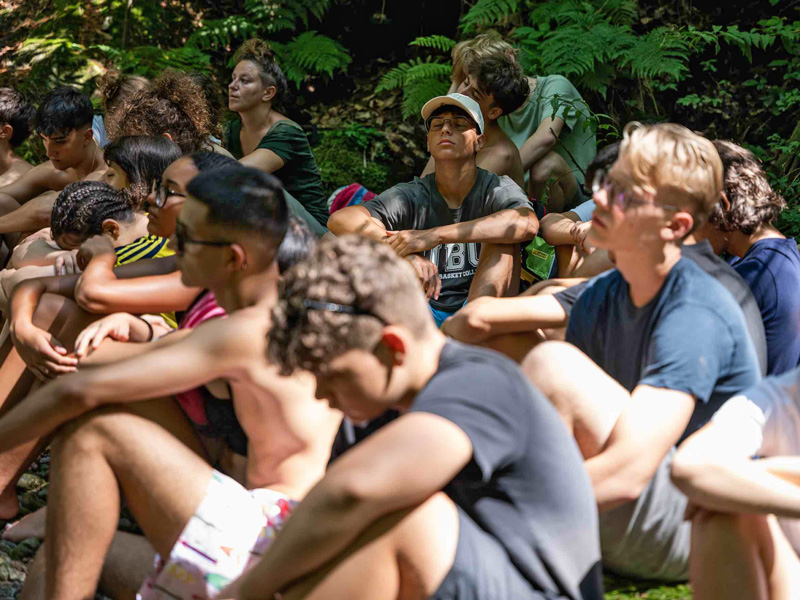
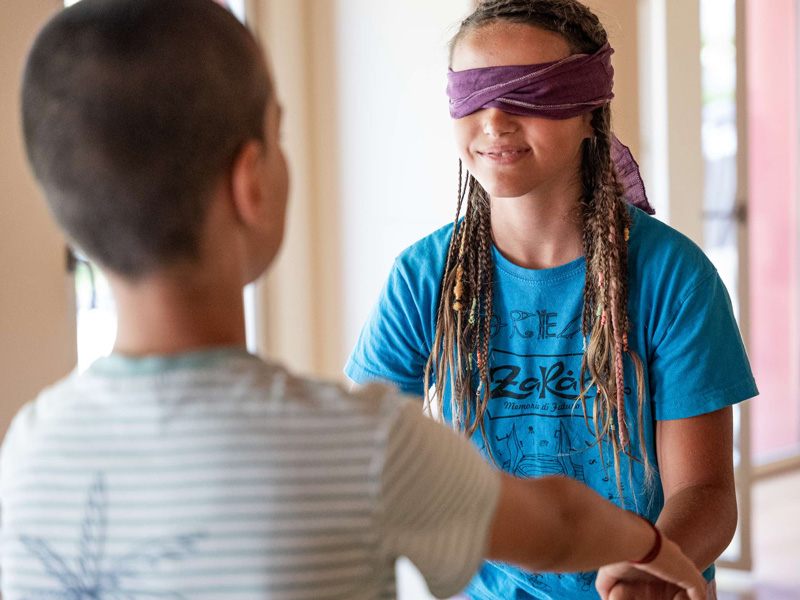
In 2022, the summer camp was structured as a residential tent experience and officially became part of the center’s activities. Caterina explains: “Our goal is to offer something that’s often not found elsewhere. We want to welcome the kids in their entirety: to pay attention to their inner selves and allow them to express themselves without fear of being judged.” All camp activities take place in nature: “Furthermore, we want to bring the children back to nature and the struggle of achieving something, to foster resilience and a sense of satisfaction. For example, they have to reach the top of a mountain on foot: success in this endeavor boosts their self-esteem.” She adds: “We also want to offer the kids the teachings of Lama Michel. We do so without religious references, although Buddhist concepts are sometimes mentioned.”
Since 2024, the camps have also opened to teenagers. I ask her what the teenagers who decide to participate in this experience are looking for: “At first, they may be pushed a little by their parents or because their friends come. Then they return because they feel listened to and not judged, they feel at home and free to express themselves. That’s why they also share their difficulties and problems at the camps.”
We ask her how the educational experiences with parents began: “They arose from the parents’ needs, which we gladly welcomed. We’ve noticed that there’s a difficulty in conveying important values to their children and a difficulty communicating with them, as well as fears for their future.” Caterina explains further: “Today, we parents face a difficult task because our children live in a context based on appearances and superficiality. This worries us. So it’s important to get involved and work on ourselves to gain some more tools to help our children.”
Caterina concludes: “For me, it’s about planting seeds for the future and also sharing our experience of inner peace and our attempt to be and do things connected to humanity and nature through spirituality.”
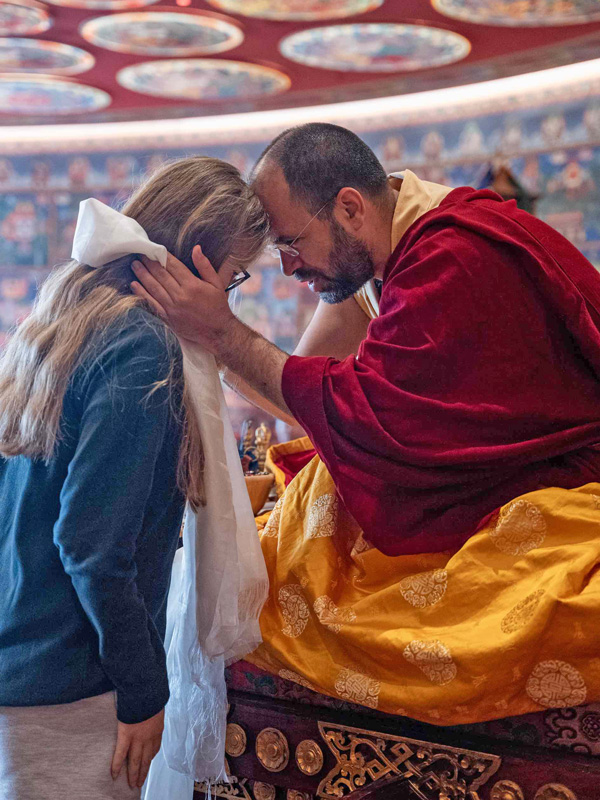
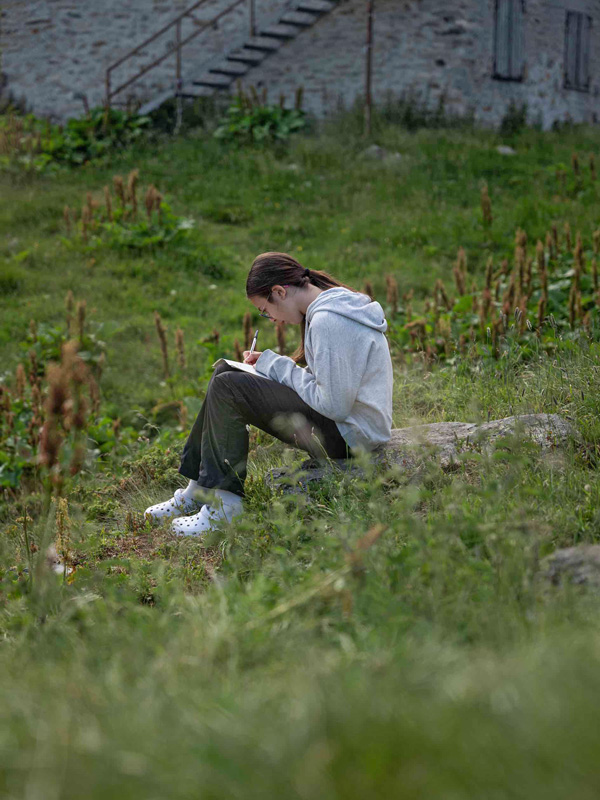
Cinzia Tumiotto and Rocio Blanco Rubio, along with Caterina, organize the camps, joined by many others who donate their time, passion, and expertise.
In particular, since 2023, an association of young actors, musicians, and educators has been collaborating with these residential experiences. They use the language of theater as an opportunity for personal growth and awareness of their connection to nature. It’s called Teatro Selvatico and is based in Torre Mondovì in the province of Cuneo, naturally surrounded by mountains and forests.
For Teatro Selvatico, we interviewed Isacco Caraccio and Francesca Aurilio, who told us how their collaboration with Kunpen Lama Gangchen began. Isacco: “I had left a steady salary at the Teatro Stabile di Grosseto because I felt it wasn’t my place and I needed to embark on a new journey. I went to Albagnano for two weeks of karma yoga and, in my free time, I would improvise theater workshops in the meadow. Someone let me know that Lama Gangchen liked what I was doing, and the following year, Teatro Selvatico began participating in camps with children.” Francesca joined later, when the collaboration was already more structured: “I was coordinating five communities for minors in Milan, and at a certain point, I too felt the need for a change in life. So I wanted to dedicate myself completely to grounding my vision of the world, pedagogy, and art. I became fully involved in the co-design of Teatro Selvatico, and that’s when I came to Albagnano.”
At this point, I ask them what connections they see between their worldview and the Buddhist one: “It’s a bit as if these two worlds had at a certain point reconnected. Many of the teachings passed down by Lama Gangchen and Lama Michel fit perfectly with those of the avant-garde theater we’ve studied, as well as with biotransenergetics. What we try to do is bring the concepts of interdependence, impermanence, and emptiness to a corporeal and experiential level, and nature offers a wonderful space for this. Furthermore, Lama Gangchen’s culture of inner peace and biotransenergetics have given a meaningful framework to the practices we’ve been intuitively pursuing for some time.”
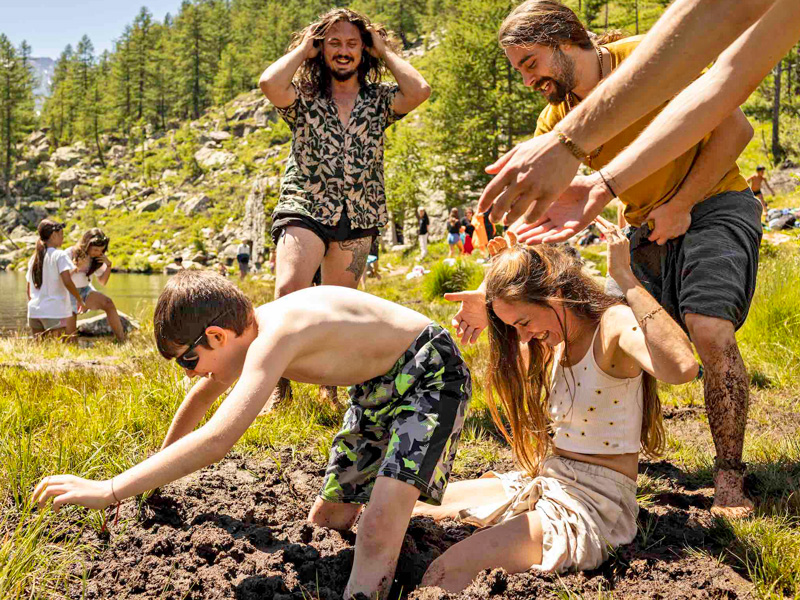
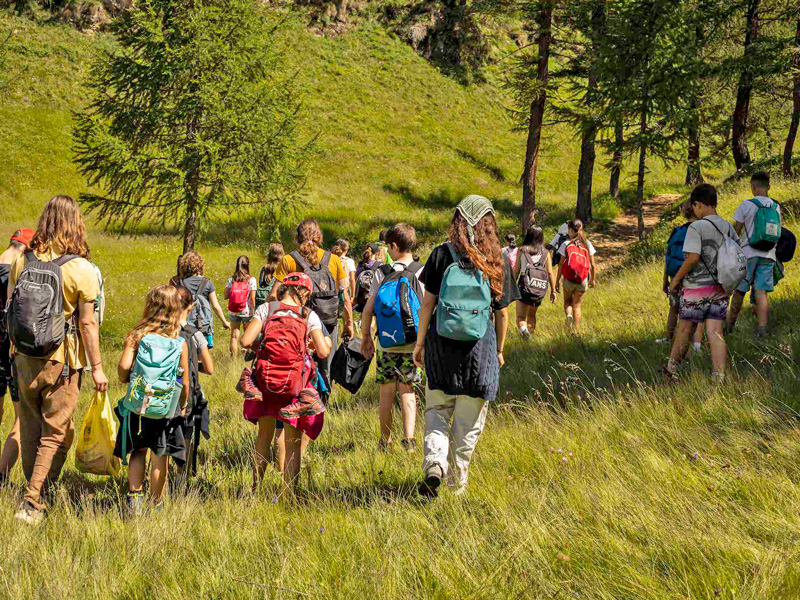
I ask them who their masters were and are: “First of all, the master is everywhere because he lives within us: he’s just there waiting to be recognized. This is why true masters are those who awaken the masters who already live within us. The master, unlike the teacher, is not someone who transmits something but rather someone who embodies the qualities that open us to paths of growth. Among these, we would like to mention Pier Luigi Lattuada, founder of biotransenergetics. However, there are also other silent masters: trees, the forest, the farmers who cultivate the land, and friends.”
Isacco and Francesca go on to explain what they hope to convey to children and adolescents through the activities they offer: “First and foremost, critical thinking and the complexity of the world: the ability to ponder questions and interrogate reality with curiosity. We also want to convey responsibility, understood not as a burden, but as the ability to respond to life. We do this by creating spaces of freedom dedicated to authentic self-listening, without judgment, and through practices and languages that engage the five bodies: physical, energetic, mental, emotional, and spiritual.”
Finally, I’d like to ask you to tell us something about the role of adults who work with children and adolescents: “The greatest job of an educator is to observe children, not to ‘straighten’ them: to observe them and give them the opportunity to learn the tools to make choices, remaining true to themselves and in harmony with the world. And what about us adults? What we can do is continue to question ourselves, study, and challenge ourselves to build a more equitable dialogue with young people. Because we can’t ask them to comply with something we haven’t already experienced firsthand.”
The camps for children and adolescents are held three times a year—in spring, summer, and winter—and attract the interest of families living primarily in Northern and Central Italy. Year after year, requests have grown, and the organizers have been forced to place several children on the waiting list. The next residential experience for children and adolescents aged 9 to 20 will be held from August 7 to 14 in Albagnano, and registration is available using this form. For information, please write to: inner_education@kunpen.it
Note: For now, activities at the Albagnano camps are conducted only in Italian.
Free donations from the Sangha: a support to rejoice in
Our fundraising efforts include several ongoing and project-based campaigns to which many people contribute. However, there is a much simpler way to contribute, characterized by spontaneity: what we call in accounting a “free donation.” This form of support involves unpredictable amounts, timing, and methods: some people drop something off at the reception desk, some use the form on the website to make an online contribution, and finally, some use a credit/debit card at the kiosk in the temple reception area. Free donations are a tangible demonstration of people’s appreciation and gratitude for the Dharma teachings and for all that the Center offers.
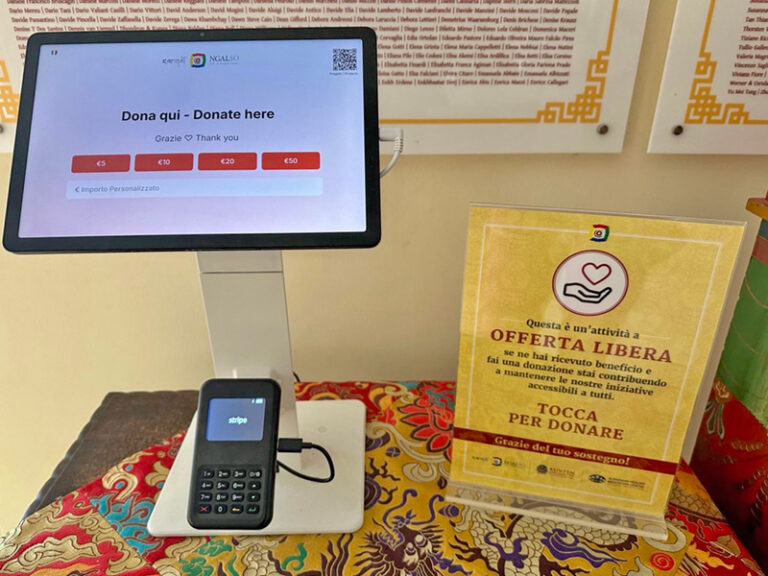
An important new development worth mentioning is the temple’s dedicated donation station that allows you to donate directly via credit or debit card. This is part of a unified system implemented a few months ago, which also includes new forms on our website and dedicated, easy-to-use accounting software. This has streamlined our staff’s back-office workload and added a new way for temple visitors and patrons to donate. Each donor can record their donation with their name and email address or make it anonymously.
To our great surprise, in 2025, the amount of free donations represented a significant portion of all donations received, equal to 12.17% of the total, a reason to rejoice in the generosity shown by so many. The Kunpen Lama Gangchen is supported primarily by donations from the sangha and the contribution to operational expenses from the Italian Buddhist Union. We are happy to see that so many have understood the value of their contribution, however small or large, in supporting the Center. Each drop of water, together with the others, forms the Albagnano mandala ocean.
The monks of Shar Gaden and the fundraising for the monastery school
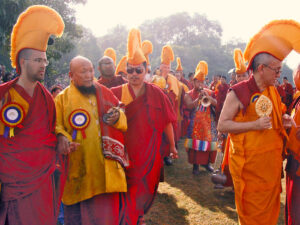
The precious presence of five monks from Shar Gaden Monastery at the Albagnano temple continues a long-standing exchange between East and West, strengthening the bonds between spiritual brothers and sisters of the Ganden Nyengyu lineage. Their names are: Jampa Chöpel, Kunchok Rinchen, Dakpa Tharchin, Kunchok Namgyel, and Lobsang Dondub.
Our temple’s activities have been greatly enriched with pujas and special ceremonies thanks to their generosity. Furthermore, the five monks have traveled locally, nationally, and in other countries to perform purification, healing, and blessing ceremonies. In addition to Italy, they have visited NgalSo centers in France, the Netherlands, and Brazil. All donations they are collecting will go to support the Shar Gaden Monastery school.
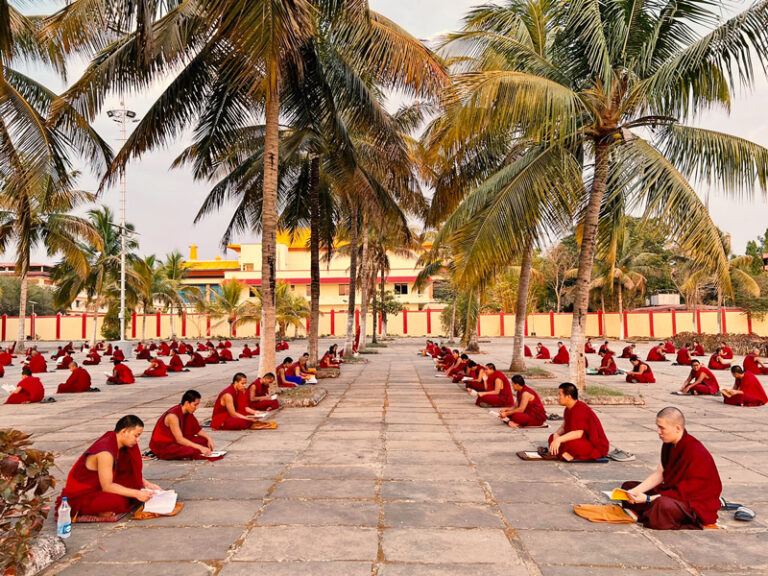
We interviewed the school’s principal, Geshe Nyima Lama, to learn more about the school’s characteristics and its ongoing evolution, thanks in part to the donations raised.
Geshe Nyima told us that the school is attended by 330 monks aged between 5 and 24, and that both monastic and general education are taught. Classes are held from 7:45 a.m. to 11:00 a.m. for monastic instruction and from 1:45 p.m. to 5:00 p.m. for lay instruction. Teachers are adult monks for Dharma-related subjects, and young Indian and Nepalese teachers for technical and general education subjects. Several foreign volunteers also work at the school.
We emphasize the importance of studying general academic subjects—such as English, mathematics, natural and social sciences, and computer science—as well as artistic and practical disciplines. While monastic education, including the study of the Tibetan language, memorization of sacred texts, Buddhist philosophy and psychology, and debate, are at the heart of the educational course at Shar Gaden, a general and technical education is essential to navigate today’s world. Whether young monks decide to continue monastic life or pursue another path, theoretical and practical training is essential.
We asked him to tell us something about the facilities where classes are held. The school building has two floors and 30 classrooms, plus a yoga room. A third floor is currently under construction. There’s also a debate hall, a large, wall-free area covered by a sheet metal roof. Geshe Nyima tells us that there are also plans to build a multipurpose sports field.
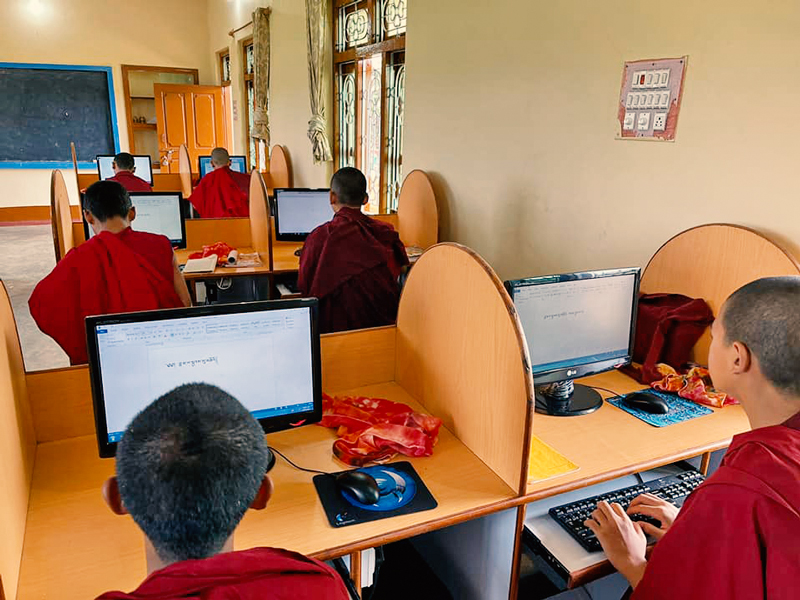
At the end of the conversation, we touch on a sensitive topic. The monastery has initiated the school’s registration process so that the young monks can take exams and obtain their diplomas. Geshe Nyima tells us that the process is long and complex, and they don’t know when this will be possible.
The donations raised by the monks through private pujas have been crucial to supporting the school’s costs and the monks’ studies. This has allowed all those involved in administrative and teaching activities to continue their work without worrying about finding a way to support themselves financially.
A special thanks, therefore, goes first and foremost to the five monks who help us keep the Albagnano temple alive, and to all those who, with their donations, are helping to support the Shar Gaden monastery school.
If you would like to request a healing, purification, and blessing ceremony/puja for your home, office, or other work or private spaces, please email us at carlotta@kunpen.it
Retreats at the Albagnano Temple: a precious opportunity to practice in depth
At our temple, you can participate in collective meditation retreats several times a year. Retreats can last from a weekend to several weeks and are led by lamas or other resident and non-resident masters. The latest of these, at the end of April, is the retreat dedicated to Kurukulle, a female manifestation of Buddhahood that helps develop the power of attraction toward the Dharma and all virtuous aspirations.
We interviewed Lama Caroline and Francesco Prevosti to learn more about the benefits of retreats for practitioners and the best ways to approach this experience, especially for first-time practitioners.
Lama Caroline begins by explaining what a retreat consists of: “Going on a retreat means creating a space between your mind and the ordinary world we live in, distracted by many activities and worries. It means turning off your phone, stopping watching the news, and focusing on something positive. For example, we can focus our attention on becoming kinder or more peaceful. Through meditation, we gradually develop the habit of being this way naturally. Retreats exist in various spiritual traditions, not just Buddhism. The central point of a retreat is to spend more time with your attention focused inward rather than outward.“
We ask her what’s special about retreats in the NgalSo tradition created by Lama Gangchen Rinpoche: “Lama Gangchen said he was an eighteenth-century lama who suddenly found himself in the twenty-first century. In the NgalSo approach, all the ancient methods of Tibetan Buddhism are adapted and made accessible to modern times because lifestyles have changed: in ancient times, there was plenty of time for meditation; there was no TV, internet, or the busyness of today’s life. Today, we need more direct methods to heal, recover, and regenerate energy on a personal, environmental, and social level.”
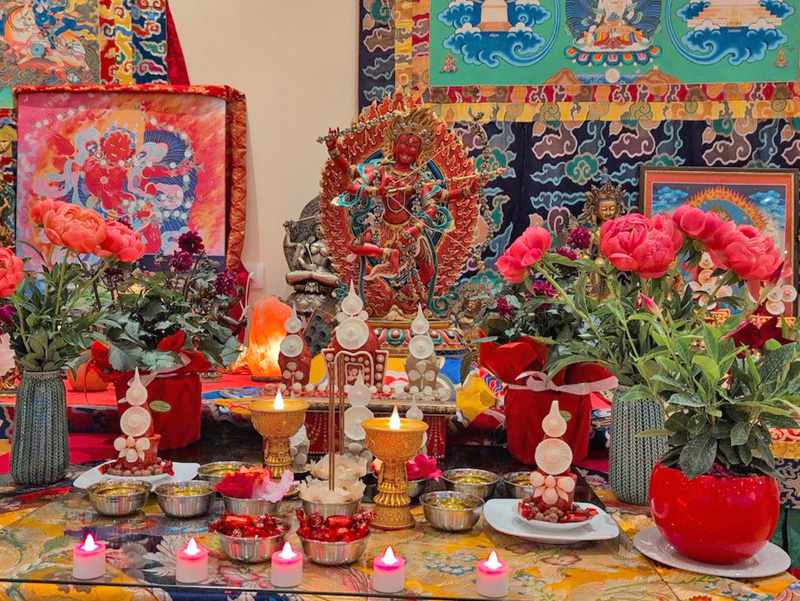
We request her for some advice for those approaching a retreat for the first time: “First of all, it’s a very beautiful thing. It’s worth starting with a short retreat of two or three days. At first it seems difficult because you don’t know what to do and you’re overwhelmed by many distractions, but little by little you learn to sit still and become calmer. It’s important to choose a meditation deity or a subject you’re drawn to: for example, Chenrezig, the Buddha of Compassion, or Maitreya, the Buddha of Love. Going on a retreat is like painting a thangka (sacred Tibetan painting): the image emerges little by little, just as the mind slowly acquires new habits.“
Finally, Lama Caroline invites us to consult the websites of NgalSo centers around the world, browse the programs, and see if there’s a more convenient retreat and location to try this experience: “Participating online is an option, but being physically present is much better.“
Francesco Prevosti was one of Lama Gangchen’s first disciples and collaborators and is one of the masters at our Center, for which he leads meditations and teachings, the latter primarily in Milan. Francesco reminds us that “focusing energy solely on spiritual development isn’t easy, but it has very significant results. A retreat can have different purposes, for example, clarifying the mind or increasing the ability to concentrate. A retreat is often also the consequence of a commitment made during initiations.”
We ask him to share some memories related to Lama Gangchen and retreats: “Lama Gangchen knew that people have little time, so with his well-known pragmatism, he insisted that people primarily do accumulations of mantras. Indeed, people very close to him have recited hundreds of thousands of mantras over the years. At that time, Rinpoche was generally more inclined to take people on pilgrimages than to conduct retreats, but it happened that retreats were also conducted in these contexts, for example in Kathmandu.”
Francesco continues: “In ordinary people like us, retreats are very moving internally and bring out things from the past that may have been repressed for years, and sometimes it can be quite a powerful experience. Different things can also emerge depending on the mantra and the meditation deity. I have experienced this myself several times.”
We also ask him for advice for those who want to try a retreat: “It’s important to remove yourself from everyday worries and base your participation on one of the three Lamrim motivations: aspiring to rebirth in a human body, liberation from the suffering of samsara, or enlightenment. If a retreat is undertaken with only worldly motivations, from a Dharma perspective, it’s pointless. It may be useful for relaxation, but not for spiritual progress.”
If you’d like to stay informed about retreats organized at our Center, you can consult the calendar on our website or subscribe to our newsletter (at the bottom of the website) and our WhatsApp channel.