Contents
On reincarnation: Trijang Choktrul Rinpoche explains the term tulku to us
Not just Italian and English: our publications in multiple languages
Albagnano’s educational proposals: being oneself to open one’s heart to others
According to modern scientific view, when the physical body ceases to function, the mind also meets the same fate. This is not the case in the Buddhist view, according to which the mind continues. Thus begins the rare and precious interview conducted by Lama Michel Rinpoche with Kyabje Trijang Choktrul Rinpoche — the reincarnation of Kyabje Trijang Dorje Chang, who was the teacher of Lama Gangchen Rinpoche and tutor to the 14th Dalai Lama.
But what does that sentence mean? Is the mind that continues the same one from body to body? Things seem to get a bit complicated for us Westerners, steeped as we are in positivist science and far removed from these concepts. That is why we need to gain a deeper understanding of how the process called reincarnation works.
We are all reincarnations — Trijang Rinpoche explains — and animals are, too. The difference with a realised being — a buddha — is that the latter reincarnates by choice and with the aim of helping other beings; we, on the other hand, reincarnate driven by our mental poisons and karma. That is why, in the case of a realised being, we use the word tulku — which literally means “emanation body” (nirmanakaya) — to refer to their reincarnation. Trijang Rinpoche tells us that a realised being decides where and how to be reborn. How is this possible?
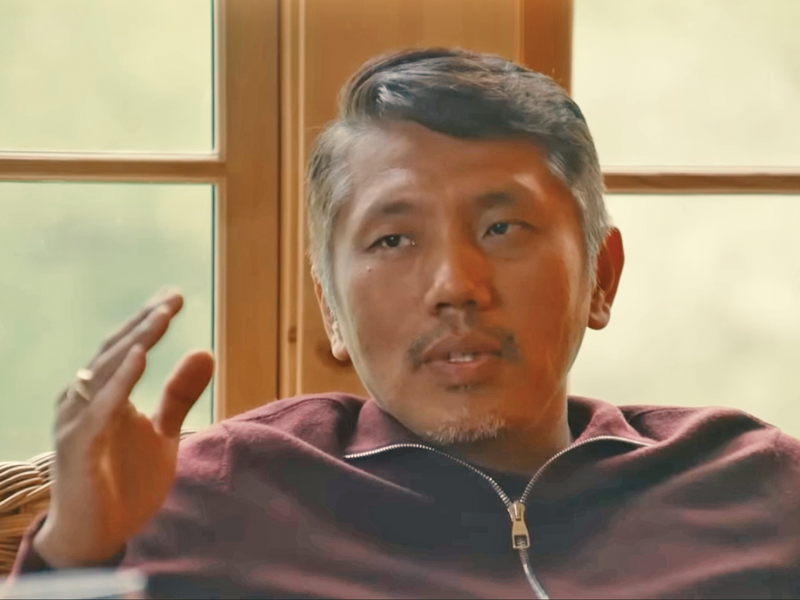
The deeper we delve into the subject, the more the concepts overlap. At a certain point, Trijang Rinpoche cuts the discussion short, saying that technical explanations do not help much. He then uses the example of a candle to clarify our doubts. The mind is like the flame of a candle that allows other candles to be lit. The light remains the same, even though the candles differ. That light represents the mental continuum that persists from one life to the next. The mind is not identical, yet something profound from the previous mind carries over into the subsequent one.
Trijang Rinpoche goes on to explain that we are all born with certain imprints — certain predispositions. Where do these come from? The Buddhist answer is simple: from past lives. It is not easy for us to view things from this perspective; we generally seek explanations using the knowledge provided by modern sciences — such as physics, chemistry, psychology, and so on. Yet, even by combining this valuable knowledge, we lack convincing answers to some of humanity’s fundamental questions, such as: where does consciousness originate?
The interview with Trijang Rinpoche will be part of a documentary — directed by Nico Miranda and Rocio Carbajo and written by Lama Michel Rinpoche — that offers an in-depth look at reincarnation in general, and specifically at the reincarnation of our Centre’s founder, Lama Gangchen Rinpoche, who chose to return among us to continue guiding us on the path of inner peace in the person of Francesco Naropa.
Last May, Lama Michel Rinpoche — accompanied by a group of disciples — visited Trijang Rinpoche in Vermont. Francesco Naropa and his parents were also part of the group. It was a special occasion, as Trijang Rinpoche and Francesco Naropa met and spent time together for the first time. In the interview, Trijang Rinpoche tells: “When I saw Francesco Naropa, I was happy to meet my friend again, but at the same time sad because my friend was no longer there.” This admission is one of the most moving moments of the interview, offering a truly intimate glimpse of one tulku meeting another tulku with whom he shares a bond spanning lifetimes.
Witnesses to this meeting observed the affection and special connection between the two. Among the moments they witnessed, one stood out in particular. At one point, Francesco Naropa asked Trijang Rinpoche, “But why do you live so far away?” He replied, “Because I look after this part of the world, while you look after the other.”
Thus concluded a journey that opens the way to a new story — one that is also our own. We need teachers to guide us with love and wisdom through a confused and disoriented world. May the teachers enjoy long lives. May the conditions for Francesco Naropa’s growth and education be the very best, so that he may bring benefit to all beings.
If you are reading this news, you are part of this story. Your curiosity, your friendship, and your support help keep this place alive.
If you have browsed the books and sadhana texts available at the Albagnano shop, you may have come across unusual titles like Hoe brengen we spiritualiteit in ons dagelijks leven or Un arcoíris de néctares curativos. Why are they there? After all, isn’t it enough to have our books in Italian and English — the language of our main Centre’s home country and the primary language of the international sangha?
For years, many friends have dedicated time and effort to translating our lineage’s key books and sadhanas into other languages — specifically German, Dutch, and Spanish. We interviewed some of them to discover the advantages and benefits of making these texts available to international visitors and disciples who come to the Temple.
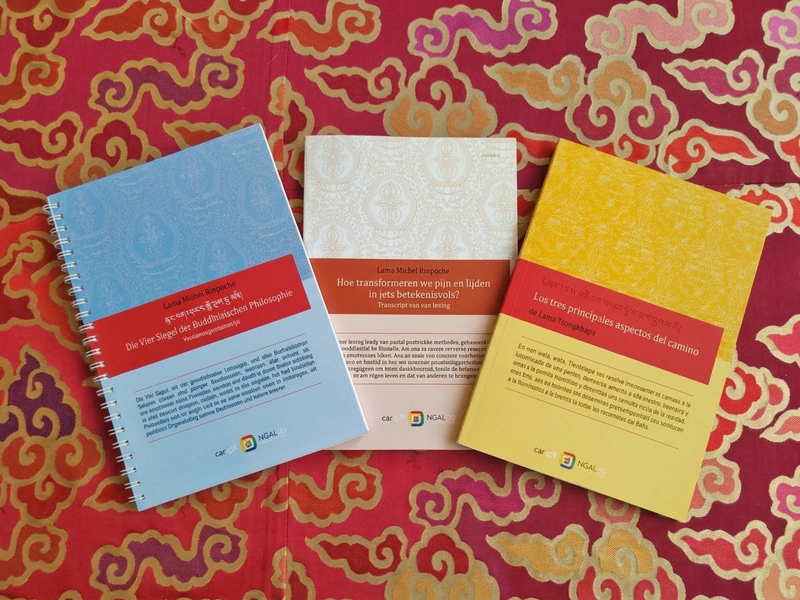
After meeting Lama Gangchen in 1998, Maria Corniero placed her professional skills as a translator at the service of her teacher and the sangha, as part of a larger team working in Spain, Argentina and Chile, often with limited resources: “It was a way to give back a little bit of all the richness my teacher brought into my life. Preserving his precious teachings in Spanish felt somewhat like continuing the work of one of his previous incarnations: indeed, in the 12th century, Trophu Lotsawa translated important texts from Sanskrit into Tibetan. Today, the real challenge lies in conveying a worldview and concepts — distant in both time and space — into a modern Western language.”
Irene Zwaan lives right here in Albagnano and tells us: “Since 2012, I have been working on translating the texts of our teachers into Dutch. Whenever Lama Michel Rinpoche visits the Dharma centre in the Netherlands, we arrange to present a new translation of his teachings. It is not easy to render his language — which is so personal and accessible, yet accurate — into Dutch. Nevertheless, our sangha appreciates being able to read titles like The Nature of Reality or The Path to Happiness in their native language.”
Finally, Kris Dohmen — who has also been at Albagnano for several years — admits: “The opportunity to listen to Lama Michel Rinpoche in the gompa allows me to better process his ideas and talks when I translate his teachings into German. I have been working on translations for about ten years, and I have seen that transcripts of short teachings in one’s own language offer people unfamiliar with Lama Michel and the Dharma a valuable opportunity to approach them through accessible, undemanding reading.”
If you speak Spanish, Dutch, or German, today you can also count on a number of titles in your own language. When you visit Albagnano, stop by the shop and ask about these books. You might even be pleasantly surprised, for once, to be able to read the teachers’ words in your own language.
If you are reading this news, you are part of this story. Your curiosity, your friendship, and your support help keep this place alive.
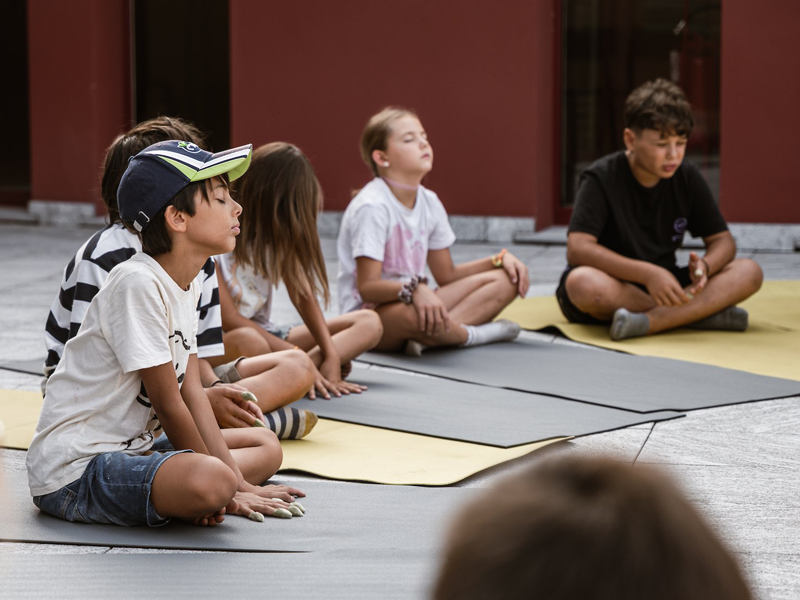
Year after year, the range of activities on offer has grown in both number and variety, extending to new age groups and introducing new initiatives. The summer camp for children that began a few years ago has paved the way for a programme of events for young and old alike, including teenagers and adults of all ages.
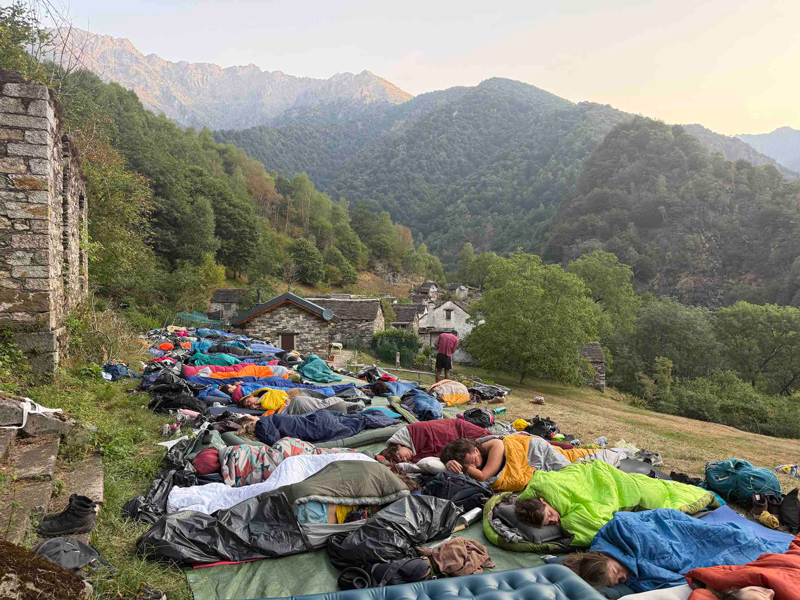
A wide range of initiatives is planned from October of this year through to the summer of 2027. The collaboration with Teatro Selvatico, now in its seventh year, will continue with upcoming events. In addition to camps for children and teenagers, there will be camps for adults and parents featuring new experiences also focusing on relationships with the environment, oneself, and others.
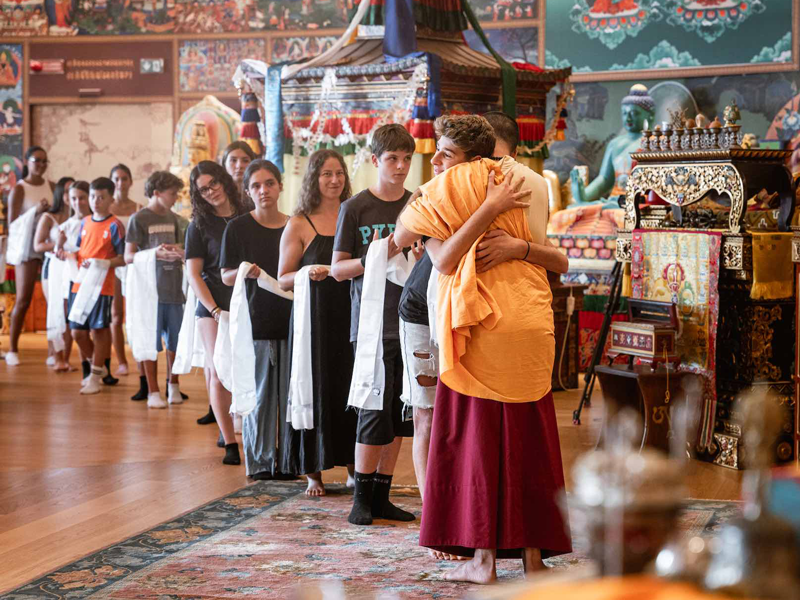
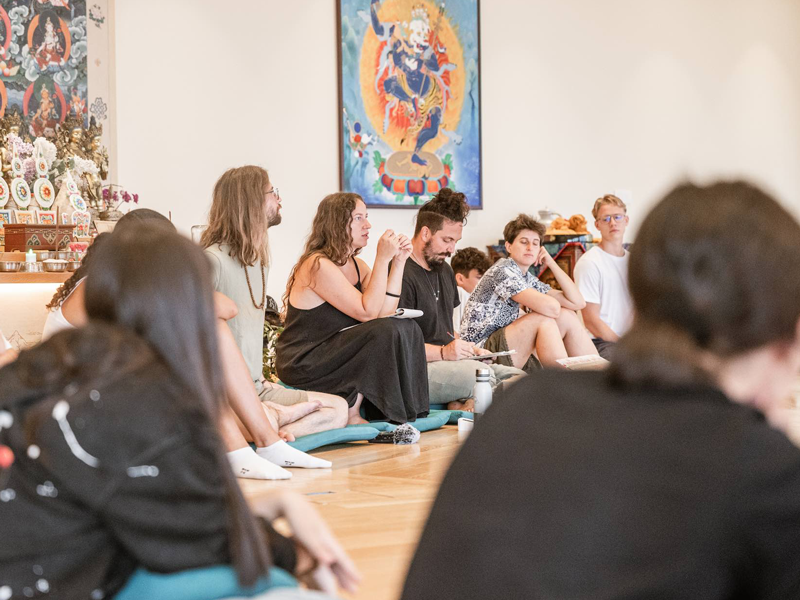
Also included are activities for younger children (ages 5 to 8) led by instructor Connie Testa, designed to guide them in exploring their inner selves. These six gatherings focus on the paramitas (perfections), introduced to the children through storytelling, yoga, imaginative play, and a variety of other age-appropriate activities. Six meetings at the Milan Centre (from October to March) and three meetings at the Albagnano Centre (from January to July).
There will be two full weeks of camps for adults and parents in June 2027. Titled “Origine,” this new initiative was developed by Teatro Selvatico in collaboration with Lama Michel Rinpoche and educators from the Albagnano Centre; it draws on various artistic mediums to facilitate self-expression and is open to everyone, with no prerequisites for participation.
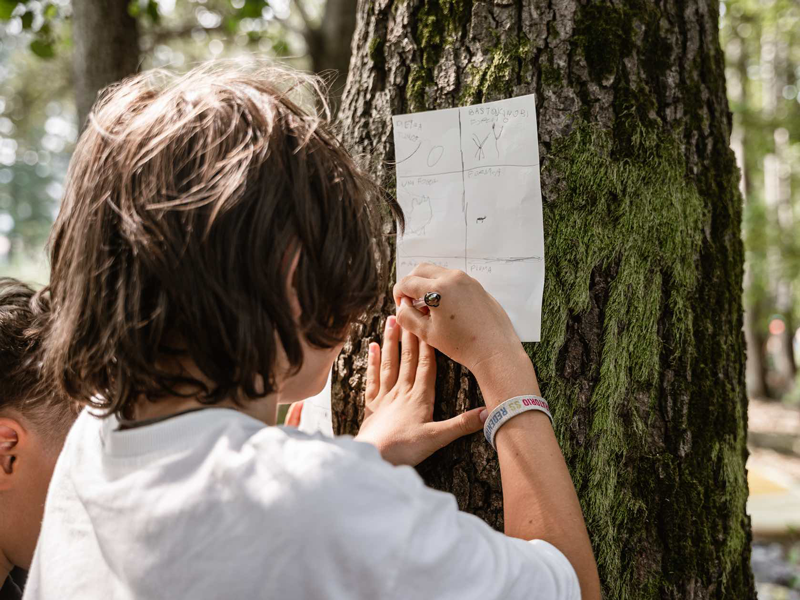
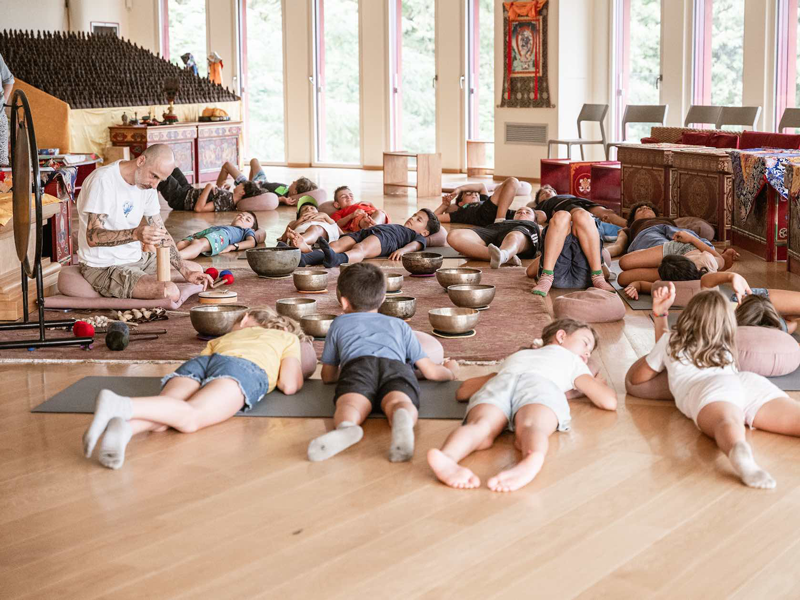
It concludes on a high note with the traditional camp for children and teenagers in July. Registration for this initiative will only be open in May 2027, so a bit of patience is needed.
At Albagnano, there are not only moments of formal teaching but also many others dedicated to experiential learning — where the Dharma becomes a matter of sharing, connection, and embodied experience, transcending the specific faith or religion one professes. These are experiences that allow one to discover the preciousness of this life and live it to the fullest, learning to love oneself and others, and to open one’s mind to reality just as it is.