Contents
- The new online membership system: a tool for active and informed participation
- The Words of Buddha: a precious treasure for our Temple library
- The Five Elements and the interdependence of nature in Albagnano
- Guiding the practices: a daily service for the benefit of all
- The path of the prayer wheels: from planning to construction
The new online membership system: a tool for active and informed participation
The new online membership system has been available for several months now, thanks to the efforts of our experts. We know that not everyone can physically travel to the Albagnano or Milan centres, and that many friends and disciples follow teachings and practices from afar, not only in Italy. Today, they too will be able to join the Kunpen Lama Gangchen Association and support it with their membership fee.
For an association, the support and interest of its members is essential. Up-to-date membership is essential for accessing the Centre’s services—particularly the cafeteria, the canteen, and guest house—as well as for voting on the annual budget and electing candidates for the Board of Directors, whose positions are renewed every three years. Above all, membership is a concrete and simple way to be part of the Sangha, the spiritual community that walks together on the path indicated by the Buddha.

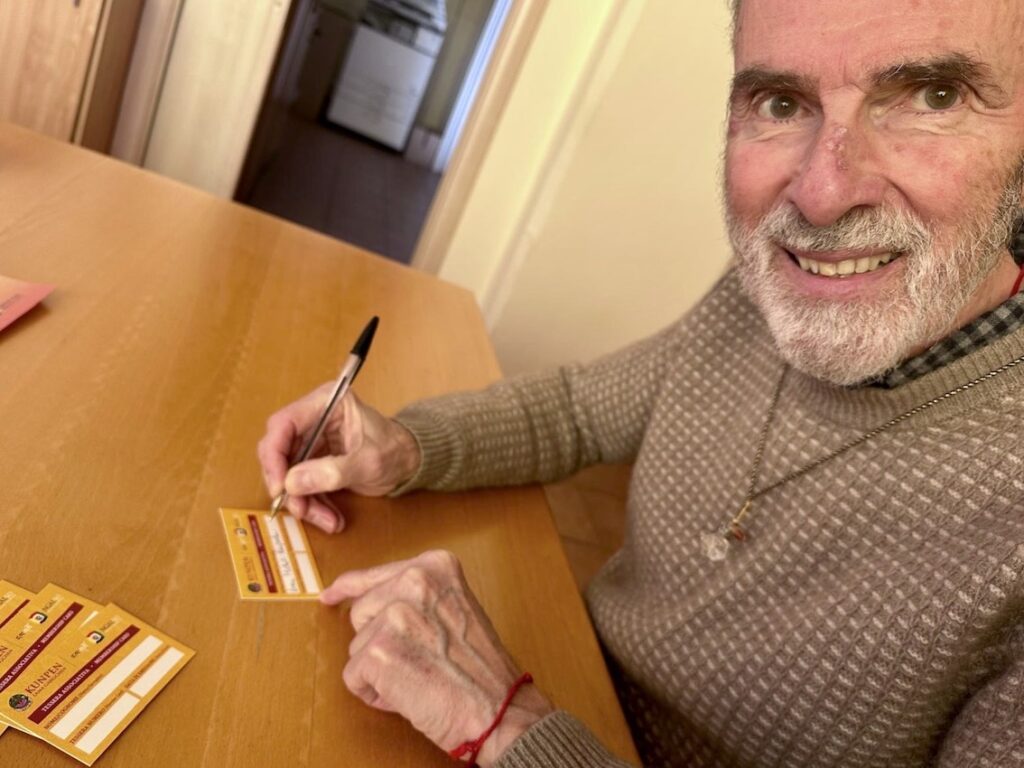
We interviewed Aldo Marzano, president of Kunpen Lama Gangchen, to learn more about the value of this small gesture. Aldo explains: “I remember very well our first meeting with Lama Gangchen Rinpoche. On that occasion, Rinpoche explained to us that kunpen means ‘for the benefit of all beings.’ It’s a direction he pointed out from the beginning and continues to guide us today. Membership is no longer just an item in the budget, albeit an important one: it has become a tool for conscious participation. It means being part of a community that has grown over the years. Today, those who become members choose to share a way of being and behaving, actively participating in the growth of the Centre.”
We also asked the president to tell us something about the benefits that online membership brings: “Online membership isn’t just a technical convenience: it’s a way to bridge distances. It allows those who can’t be physically present to still feel part of our community and helps us better preserve this bond, bringing it to life.”
This opportunity we now have may seem something small, but it has required months of intense work by Steve Fontaine, programmer and responsible for IT and technical systems at Albagnano Healing Meditation Centre. Our thanks go to him for this important advancement, along with everyone who contributed to adapting the system to the Centre’s reality.
To join the Association, simply go to our website’s homepage and click “Membership Application.” You will be guided through the registration and creation of an account, or, if already registered, you can access your personal area using your email address and password and renew your membership for the current year.
The Words of Buddha: a precious treasure in our Temple library
The “Ocean of Relaxation” Library, located on the top floor of the Temple of Heaven on Earth, is a space strongly desired by Lama Michel Rinpoche since the Temple’s design phase. Lama Michel believes that, in this age pervaded by social media, reading on paper is a precious opportunity to practice concentration without the constant and excessive stimuli of digital media. Among the library’s volumes in traditional Tibetan (called petcha) and Western formats, one of the most important collections is the Kangyur, a collection of the Buddha’s discourses. Although already available in Tibetan, Lama Michel’s idea is to print it in traditional format but in English language to make it accessible to all.
Thanks to the immense work of a team of translators, Dharma teachers, professors, and technical staff, and the support of the Khyentse Foundation, the English translations have been made available year after year on the website 84000.co. For a year now, a team at our Centre has been working to ensure that the Kangyur texts are laid out, printed on rice paper, wrapped in brocade, and catalogued in our library so they can be accessed by all. This is an ambitious project that requires considerable time and expertise, as well as special equipment such as a printer specifically designed for the petcha format and rice paper. For several months now, it has been possible to support the project with a donation. In addition to this option, the possibility of sponsoring a specific text has recently been introduced: the specific methods for doing so are explained on our website.


To gain a deeper understanding of the work being done by the team involved in the project, we listened to Lucia Musto’s explanation. Lucia has worked in publishing for many years, handling large volumes of complex texts. For this project, she is responsible for coding the texts from the 84000 site, laying them out using InDesign, and preparing the PDF file for printing: “When I was asked to collaborate on this project, I was deeply moved. It’s a task that requires concentration, patience, and enthusiastic effort. Reading every single line of Buddha’s texts makes me feel his words deeply in my heart: this work has become a practice that is bringing me great benefit.” Sharon Dawson assists Lucia in proofreading the texts, which are then returned to Lucia for final corrections. Finally, Alaor Cunha proceeds with the printing using a special machine meticulously tested and purchased for this purpose.
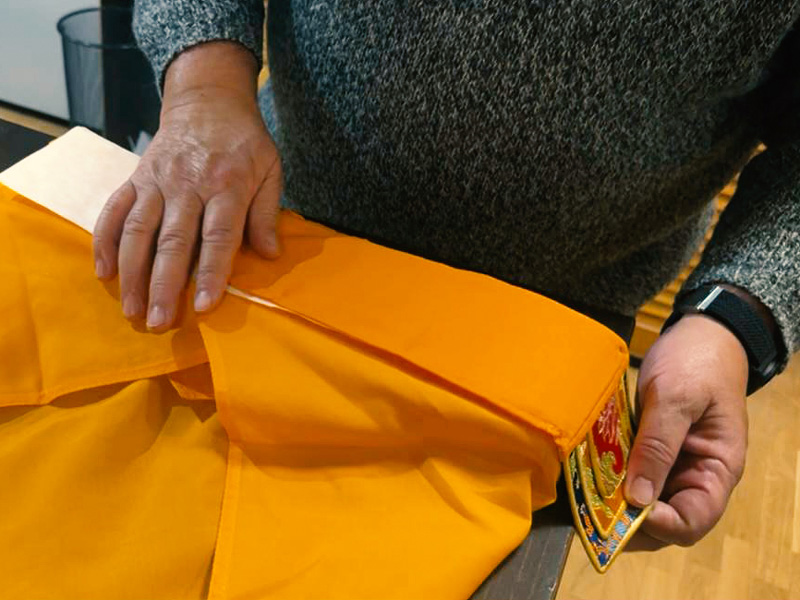
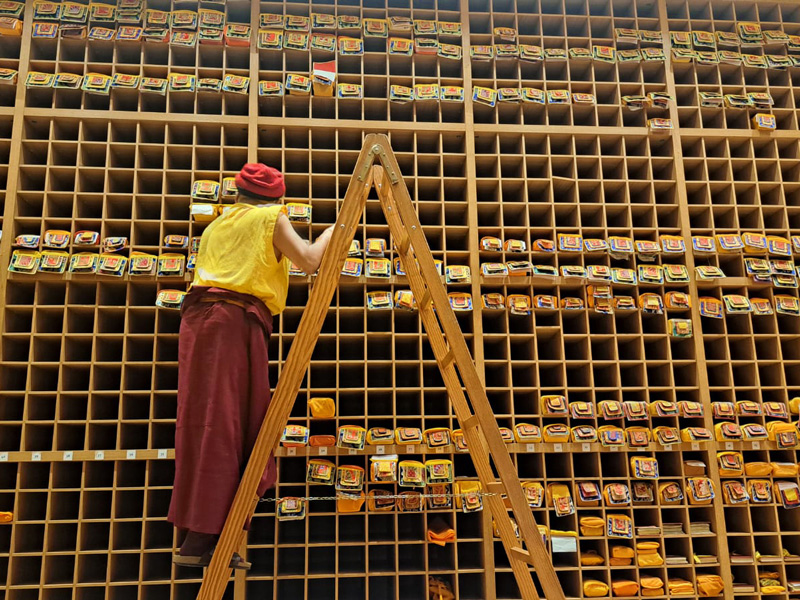
Kris Dohmen, as library coordinator, is responsible for cataloging the volumes in the software that contains the titles of all the books on the shelves. Kris tells us: “Libraries are much more than just storage places for printed paper. In the words of Buddha, the “enlightened one,” the sum of his thoughts for healing the body and mind are manifested. So, figuratively speaking, those who enter the library enter a space of consciousness that helps them contemplate these thoughts.“
Twelve texts have currently been formatted and printed. The first to be wrapped in brocade, catalogued, and placed in the library was Lalitavistara, which has been available to anyone wishing to consult it since November 30th. This treasure, available to all of us, is a priceless gift to which many people are contributing with their donations in addition to the team directly working on the project. We extend our gratitude to all of them for their invaluable support and for the benefit that the Buddha’s words imprinted in the Kangyur will bring to so many.

The Five Elements and the interdependence of nature in Albagnano
Those arriving at the Albagnano Centre find themselves immersed in an immense green space of gardens and woods that surround the stupa, the Temple, and the other buildings, extending to the parking lots. The most observant people notice something special in the care taken to maintain this splendid natural environment, home to both ancient and recently planted trees, along with shrubs, flowers, and medicinal plants used for herbal tea. Visitors sense a vitality not found in other gardens. The structure behind this natural environment, in fact, is not simply visual and aesthetic, but draws on the concept of interdependence, which—in addition to being central to Buddhist philosophy—is also the foundation of Permaculture.
Pete Webb, who cares for and coordinates the Temple gardens with the help of Nathan, is a Permaculture expert and explains how interdependence underpins this approach to caring for the natural environment, understood as all living beings—plants, animals, and humans—and the elements that compose it, in relation to each other.
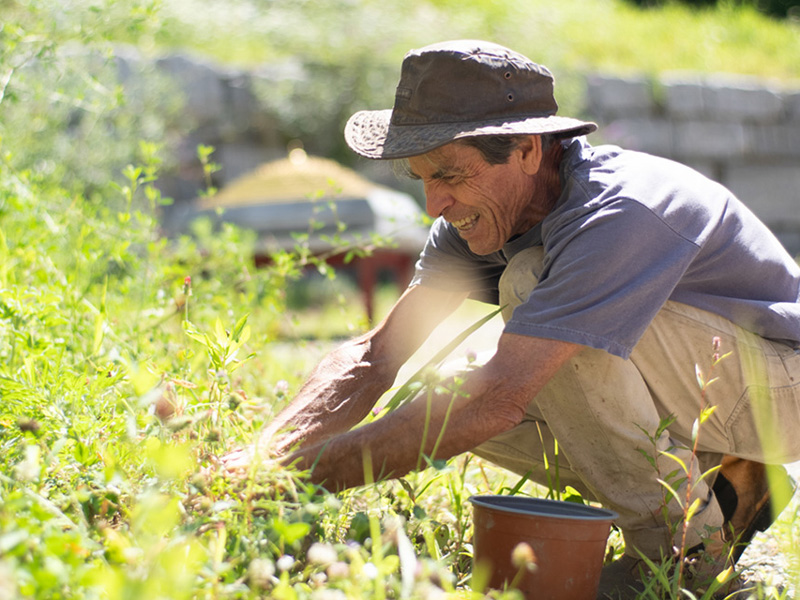
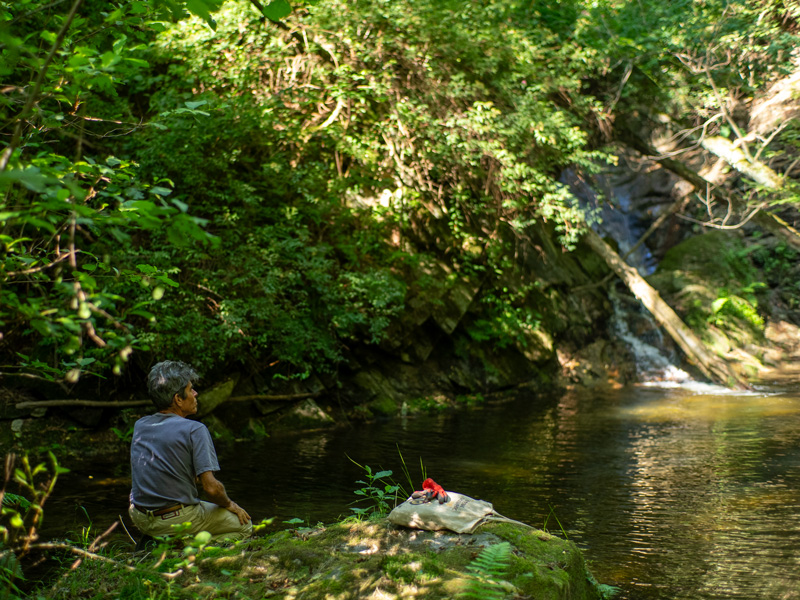
We first asked Pete to tell us how he came to Albagnano: “Every year Lama Gangchen Rinpoche, along with Lama Michel, visited the land where Bel (Lama Michel’s mother) and I welcomed people and groups who wanted to learn from nature through non-formal education. Year after year, he saw the changes taking place and said to me: one day you will come to Albagnano. In 2010, I helped plant some of the first fruit trees that are now found in the gardens: plums, persimmons, and figs. After Rinpoche passed into parinirvana in 2020, we moved here permanently to be close to Lama Michel and to help the Sangha.”
We asked him what the gardens were like when he arrived: “Between the Labrang (the lamas’ house) and the Centre, there were terraces overgrown with black locust, an invasive plant that was cut down from time to time. The Temple was still under construction, so there was a lot of coming and going of excavators, and the soil was severely disturbed. There were signs of a vegetable garden where the parking lot is now, but it had long since been abandoned. In general, there weren’t many plants, except around the Buddha Garden and beyond the Centre building. It was the Covid period, and I spent a lot of time in the woods and in the mountains exploring the area; for example, I wanted to understand where the water came from. And I discovered one of the few remaining sources of free water is the one that flows from under the Temple.”
The location of the Temple and Buddhist Centre is special, and Pete explains why: “It’s a windswept area rich in water sources. For these reasons, as well as for its tantric practices, Albagnano is a place dedicated to inner transformation. For this reason, it can sometimes be too intense, and not everyone is ready to embrace this strong energy.”
At this point we ask him in what sense interdependence underlies the interaction between beings: “The natural environment has been in constant transformation for millions of years, a period during which sentient beings have also transformed. As Lama Michel teaches us, every interaction leads to a transformation. Therefore, first of all, it is important to observe how beings and elements interact with each other and learn how they work. Our tendency, instead, is to act and do things according to our habits: cutting, planting, repotting, adding, removing, without realising that every unconscious human modification potentially causes trauma to the natural environment. To understand the dynamics of nature, it is important to continuously observe, even without doing anything—just as in meditation we observe our breathing—and then proceed with small, minimally invasive interventions because nature has its own evolutionary patterns and its own timescales, which differ from place to place.”
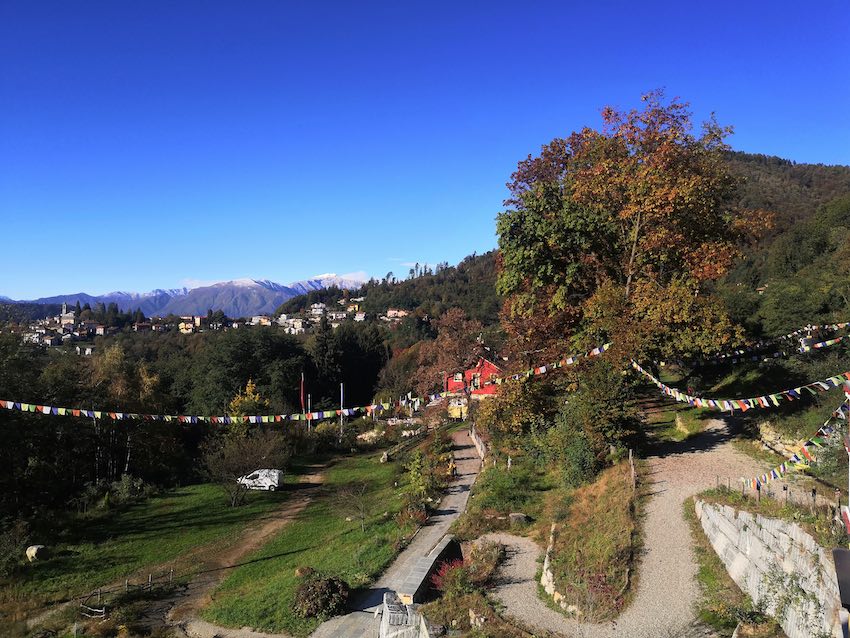
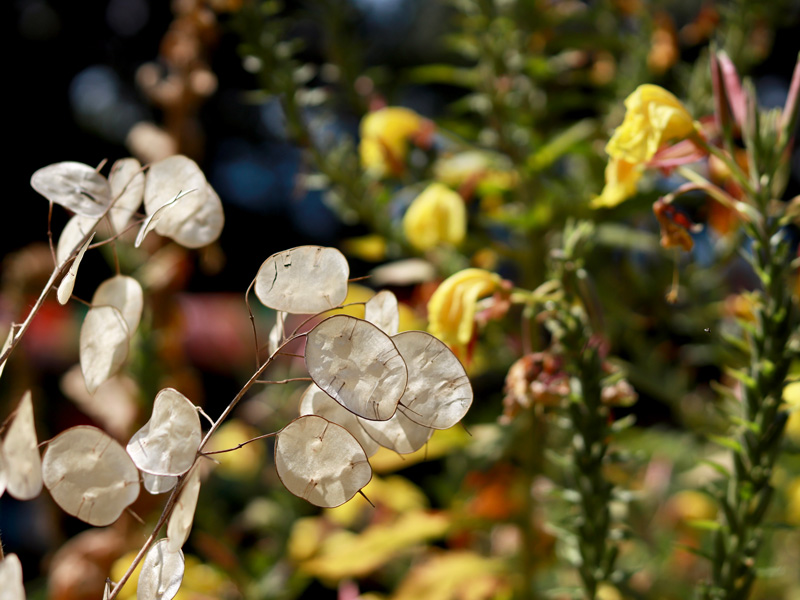
He adds: “In the gardens and forest around the Temple, I made various experiments to help the soil develop and to see which plants liked this type of soil and climate and which didn’t, even just by carefully scattering seeds here and there. I remember when Lama Gangchen came to our land in Brazil. One day, he was walking along a path followed by a long and joyful line of people, and he would take handfuls of the seeds I had prepared and throw them back and forth like rainfall.”
Pete wrote and published a book titled How plants are born: “Lama Gangchen knew Bel had published many books. One day he came to me and said, ‘Now it’s your turn to write a book.’ He even gave me the title. It was a six-year undertaking and an incredible journey of personal growth.”
Pete’s presence in Albagnano is precious not only for what he does in the gardens, but above all for who he is. Learning from nature is a skill that requires patience and listening, and this is a lesson for the entire community. Pete is helping us realise that not just the plants, but the entire mountain we inhabit is alive and has its own needs. He’s showing us how interdependence works in nature and how we can learn from it to live more harmoniously with one another: “It’s not enough to be ecologically aware; it’s important to understand, for example, that the mountains have their own way of life. Mountains have always been powerful places because they are the source of the element water and because they are places of vision. Plants, animals and humans depend on water, and for this reason, mountains have always been sacred in all cultures.”
Finally, we asked him how to use the water source near the Temple wisely, also considering the Centre’s water autonomy project: “Water is alive and joyful when it is in motion and when it flows and descends into the valley. It’s important, for example, that the water stored in the cisterns be kept alive, just as it’s important that some of the water be returned to the mountain. Unfortunately, today, almost all the water sources in our area have been used by municipalities to supply private homes with paid water. This has a significant impact on the mountain, and we have an additional responsibility in this regard.”
Along with Pete and Nathan, we wish to remember friends in the community who have dedicated or still dedicate time to the Centre’s gardens, in particular: Leo and Thorsten (who both passed away during the past year), Claudia, Dean, Bernadette, Thomas, Emerson, and Laura.
Guiding the practices: a daily service for the benefit of all
A special feature of our Temple is the opportunity to participate in daily meditation practices and pujas. It’s unusual to have such a rich and varied range of practices every day: even in monasteries and Dharma centres, it’s rare to find so many opportunities. Those who come to our Temple can participate in at least three daily practices: NgalSo Tantric Self-Healing, Self-Healing for the Environment and Guru Puja. On certain days, according to the Tibetan calendar, there are also practices dedicated to specific meditation deities —for example, Tara Chittamani, Yamantaka, and Vajrayogini—or pujas and ceremonies marking special calendar dates such as Kangso or the precepts for the full and new moons.
The fact that guided meditations are available at the Albagnano Temple is primarily thanks to the commitment and availability of the practice coordinators, known in Tibetan as umze. The umze at our Temple are predominantly lay people from the resident community who make themselves available. It’s worth noting that, thanks to streaming, all practices are also accessible online on the NgalSo YouTube channel.
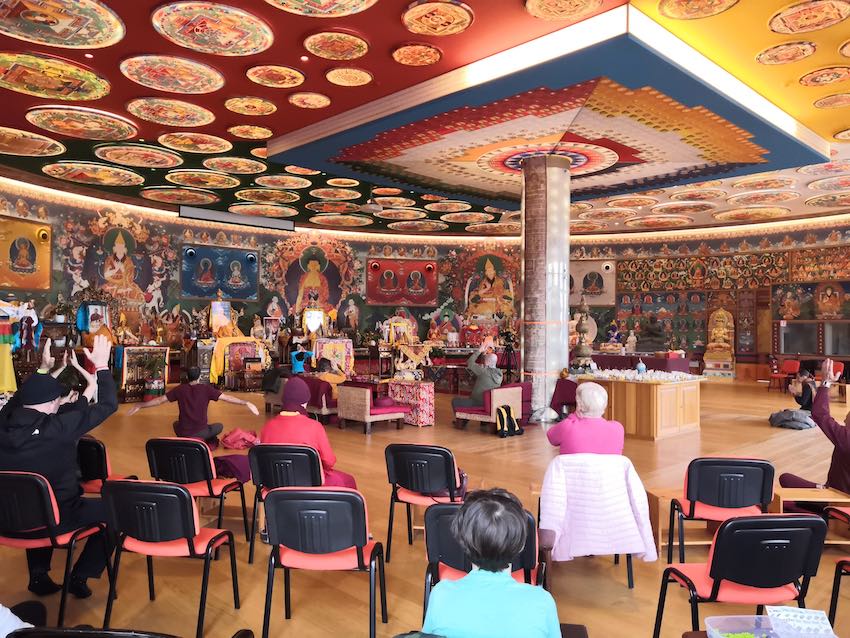
Let’s listen to what some umzes had to share about their experiences. Maria Cristina Quintili has been leading practices since 2000 and tells us: “I learned directly from Lama Gangchen and from Francesco Prevosti, who was our first umze. The biggest obstacles at the beginning were my shyness and fear of the microphone, as well as being the guide, but with a little familiarity, everything became natural.” Anneke Tabak moved from the Netherlands to Albagnano and has been leading practices since 2016: “I was at the Labrang and Rinpoche asked me to guide the Guru Puja with Mathias’s help. After a week, he told me to do it at the Temple! At first, I was very nervous and lacked self-confidence, but Rinpoche reassured me by telling me that even monks take many years to learn it.” Both of them gave advice for those who want to begin this service: “To lead practices, it is essential to have a good motivation, namely that of serving the spiritual community.” “The important thing is not to sing well or know all the meanings but to be able to recite the entire text with the attention of body, speech and mind.”
Carmen Iodice, who has led meditation practices since the early days, adds: “I have been fortunate to be a disciple of Lama Gangchen Rinpoche for most of my life. Today, many of us are able to lead practices as a result of his constant encouragement during 40 years of teaching in the West. The Temple offers many meditations, and we need many people willing to serve the Sangha and spread the Dharma.”
Janet Reijnders, who coordinates the umze group, discusses the current needs to fulfil this service. Janet explains: “Usually, those who want to begin guiding practices can do it alongside an experienced umze and gradually become independent. We currently need at least 20 umze and 10 substitutes per week. In case of emergency, Champa the nun and other resident monks are a valuable help, but we still need at least 30 rotating guides. So anyone who wants to start is welcome.” She adds: “We would also like to organise a training programme for umze with the help of Lama Michel Rinpoche and our geshes.” Anyone interested in dedicating themselves to this service can contact Janet at janet@kunpen.it
Meditation practices and pujas are not only a service to each individual’s spiritual journey, but also a cornerstone of the Temple’s existence: thanks to them, our most sacred place is continually recharged with new energy that sustains and nourishes the life of the entire Centre and the entire world through the power of prayer. For this reason, we wish to express our profound gratitude to all those who offer their time and voice to lead the practices and thus make themselves available to the community with their precious service.
The path of the prayer wheels: from planning to construction
The Mani Khorlam project is gradually taking shape. The path of the prayer wheels will bring an ancient tradition to Albagnano and provide another opportunity to meditate and engage in spiritual practices. Some of us are already imagining the day when we can make a kora in the gardens of the Albagnano Temple. This meditation in movement will bring new energy to the Centre and, in its simplicity, will allow people to participate in the Temple’s practices while also enjoying the beauty and serenity of the gardens.
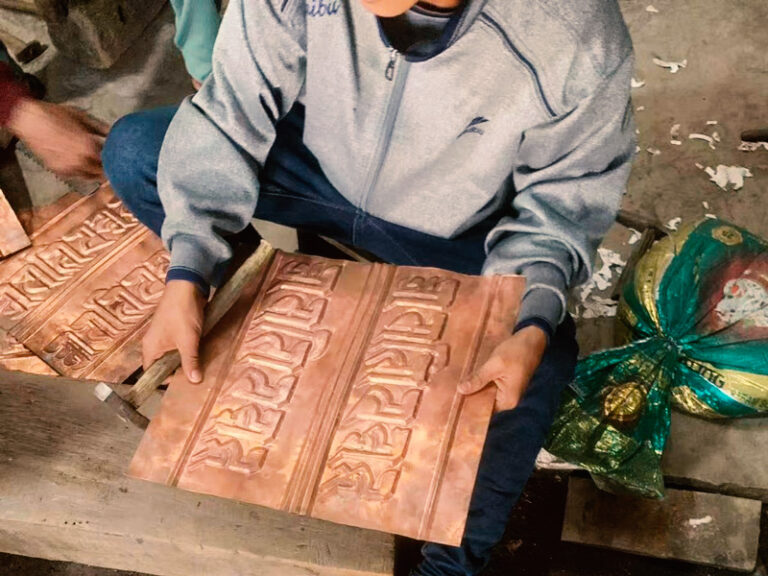
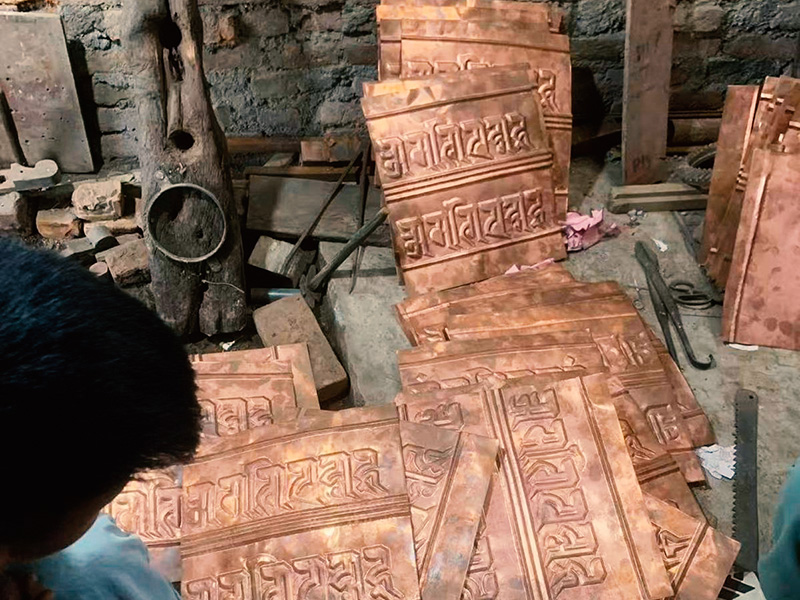
Meanwhile, Nepalese craftsmen are already hard at work creating hand-beaten prayer wheels with the mantra om mani padme hung, while volunteers are clearing the path where the granite-pebble walkway will be built.
The fundraising campaign for this project continues. 61 prayer wheels have already been sponsored—35 by the Italian Buddhist Union and 26 by the Sangha— the New Year’s Eve lottery was dedicated to supporting this initiative. The project is to install a total of 360 prayer wheels along the entire route. It is possible to individually sponsor a wheel (with the possibility to do so in 10 monthly installments) or to join together with other interested donors to sponsor a wheel.